The Breach by M. T. Hill

THE BREACH has everything going for it, a great premise, scary action tinged with an overlay of creeping terror, and a promise of a shock or two along the way. That said, however, this one fell short, for me at least, on one major count: characterisation. And anyone who knows me, and reads my reviews regularly will know, it put a great deal of emphasis on characters and their arcs. I want to see them grow, I want to see depth, I want to believe in these people and, therefore, how they’re challenged by the situations they find themselves in.

Sadly, The Breach never quite delivered on any of those counts when it comes to the two main protagonists. Whose shoulders, quite frankly, the weight of this story, and its premise, fall upon. They never really hit the right notes, especially Freya Medlock (the Journalist) who had about as much depth as the paper she was printed on. A generic female with little if any personality.

The other main character, a steeplejack by trade, Shep (short for Shepard) does at least have a little more going for him, but not much. I wanted so much more from these two, that the author just failed to deliver on. For instance, Shep is in an exceptionally dangerous line of work, he literally hangs off the side of soaring brick towers, and petrochemical factory structures hundreds of feet up in the air, in all weather.

Yet, all these scenes setting up who he is and what he does, and these amazing set pieces of daring, all fall flat. We never really get a feel for the danger he’s in. When we should be feeling his vertigo, and keen sense of awareness, we’re given a guidebook tour of the view or his wandering thoughts. And thus, the prose lack any real edge to it.

Which belies how creepy and downright horrific everything becomes—accompanied by a foreboding sense of terror—when Shep (and then later, Shep and Freya) are beneath ground during one of Shep’s ‘Urbex’ missions into a restricted abandoned site hidding a frightening secret.

It’s here, in these two chapters, that we really see everything ‘light’ up and come to life in a way only a nightmare can—in a dark, damp, creepy fashion. Making us wonder what’s behind us, stalking us from the deep dark depths of our own imaginations.

Here is Hill’s writing strength—which are too few and far between the humdrum set of the rest of the novel—that make this a terrifying read. And, as such, The Breach could have been an outstanding horror read but, in the end for me at least, it just never quite reached the finish line.

Way too much filler and not enough action.
The Silent Girls by Eric Rickstad (DNF)

I can’t go on. I mean it, I simply cannot go on … reading this book. This is one long monotonous boring read. It’s the equivalent of a long straight driveway covered in grey chippings. This endless ribbon of uniform grey that stretches off into the distance, hard and uneven under foot, unyielding in form or feature. That’s how reading THE SILENT GIRLS feels.

There’s a total lack of any emotional depth to the characters, and while the author tells us a great deal about the main protagonists past, we know nothing about him. It’s like he had a past and then, popped up in the future, as a middle-aged man looking after his dead sister’s daughter. And therein lies the problem with not only the characters, but the lack of story itself.

We’re told everything, I mean, everything, but nothing. There’s a lot being said, but it has nothing (so far) to do with the story and reads like way too much filler. And while this is supposed to be a murder mystery, there is no murder, so far as I can tell.

I read 90 pages last night, and stopped at chapter 15. Chapter FIFTEEN, and nothing has happened.

There’s possibly a missing girl, but even by chapter fifteen, after pages, and pages of filler, we still don’t know if the girl has run away, been kidnapped, or is lying dead somewhere. Because we have no breadcrumbs, no hints, no nothing about anything or anyone. We have plenty of descriptions of the countryside in up state Vermont. We know about Frank Rath’s distant past. But not why he went from being a promising detective to a washed out PI.

The only evil lurking seems to be in the imagination of the author, but he’s not up for telling us about it, yet!

Oh, don’t get me wrong. He opens the book with a superfluous prologue that does nothing for the story (so far as I’ve read), and seems to be there only to shock. Look, here’s something nasty. But even reading it just left a dull taste in my mouth because it’s so badly written as to be a weird scene lifted from a Stephen King novel. It tells the reader how evil (this being a very young child at that) people can be.

And like the scene between Rath and the run-away young woman’s father—who may or may not be a pimp, who may, or may not sell drugs—it comes at you from out of left field. One minute the two men are testing each other’s testosterone levels, and then?

Bang! Our PI with supposedly a bad back is pushing a man twice his size and weight down onto the floor in a weird confrontation that is disjointed and out of place. The whole scene is badly constructed and had me re-reading it to make sure I hadn’t missed something, it was so preposterous.

The author has Rath eyeing up every woman and female child as if (a) they’re an affront to his maleness and manhood which he needs to lock away, or (b) reacting like a pervert staring at a young girl, or getting aroused by a sales woman racking her fingernails on his wrist. Which is kind of disturbing on so many levels, let me tell you.

I cannot empathise with Frank Rath on any level, nor any character so far, and I am so bored with the writing I felt my eyes glazing over as I read. Tedious, plodding and lacking any interest or impact, you could say it’s criminal that this one ever got published.

And Fire Came Down by Emma Viskic

This is the second book in the Caleb Zelic series and, like Resurrection Bay, is relentless in its pacing as Caleb once again is trust into the centre of a murder mystery. Continuing a few months on from the aftermath of events that took place in book one, Caleb, beset by nightmares, is barely making a go of it and struggling physically and mentally. When, out for a run, he’s approached by a homeless man and given a cryptic note asking for help. Unable to resist, of course, Caleb follows the down-and-out to a dark alley and, everything from there on in goes to hell in a hand basket!

Poor Caleb, you have got to feel for this guy. So well written by Viskic he feels like someone you know or should know—a friend of a friend—he seems so familiar. Fighting the world on several fronts not least of which is battling through an ordinary day dealing with talking people, we get to know so much more about Caleb, and just how hard it is to be deaf in a speaking, hearing world. Viskic does an outstanding job of making us feel and live through Caleb’s eye. And yes, his ears too. Every missed word, every simple situation made all the more difficult by the obstacles he faces.

But Caleb is undaunted by his hearing impairment, and though he struggles, it’s made him who he is, more acutely aware of others in a way we cannot comprehend. And Viskic really reflects this so well in her writing. How he interacts with others and, just as importantly, how they, in turn, interact with him. It’s all so brutally honest.

It’s also both jarring, and so cleverly done. This is what makes for a far more interesting read, because Viskic’s characters are working within this framework, along with us, the reader. Making Caleb one hell of an interesting character never mind he’s determined, stubborn to a fault, and never, but never give up once he’s committed to doing something. In this case, finding out who killed the woman in the red dress.

With plenty of mystery, false leads, any number of ruses and misdirects, Viskic keeps things moving along at a decent pace, and never flags with both the plot, details, or character involvement. Even down to the secondary characters carried over from Resurrection Bay. We’re treated to more details and background, learn more about the community itself, where Caleb grew up, including more involvement with his younger fucked up brother, Ant.

It all makes for a thoroughly absorbing read. I was so invested in what was going on, I read this one in three very nail biting sittings. So determined to find out what was going on, who the killer or, killers, where, and whether or not we’d see Caleb get back together with Kat, his estranged wife.

And Fire Came Down takes on a lot and delivers lightning in a bottle for a second time. Tense, fraught, razor-sharp observations and, as I said, relentless. Caleb takes us on another journey of discovery, both personal and emotionally, as well as thematically. And while the ending ties up a number of threads by the end, it also poses a few more that we just know are going to be answered in the next instalment, in Darkness For Light.

While this might read OK as a standalone, I suggest reading Resurrection Bay first, as it will give more depth and background to the characters, plot, and setting. Never mind, just what makes Caleb tick.

Another outstanding read from beginning to end, I highly recommend this series.

My Gear

Inspired by Sam’s recent post in which she talks about My Gear, that being her phone, laptop and cameras, I thought ‘yeah, I need to write about my gear,’ and let you know what toys I play with on a daily basis.

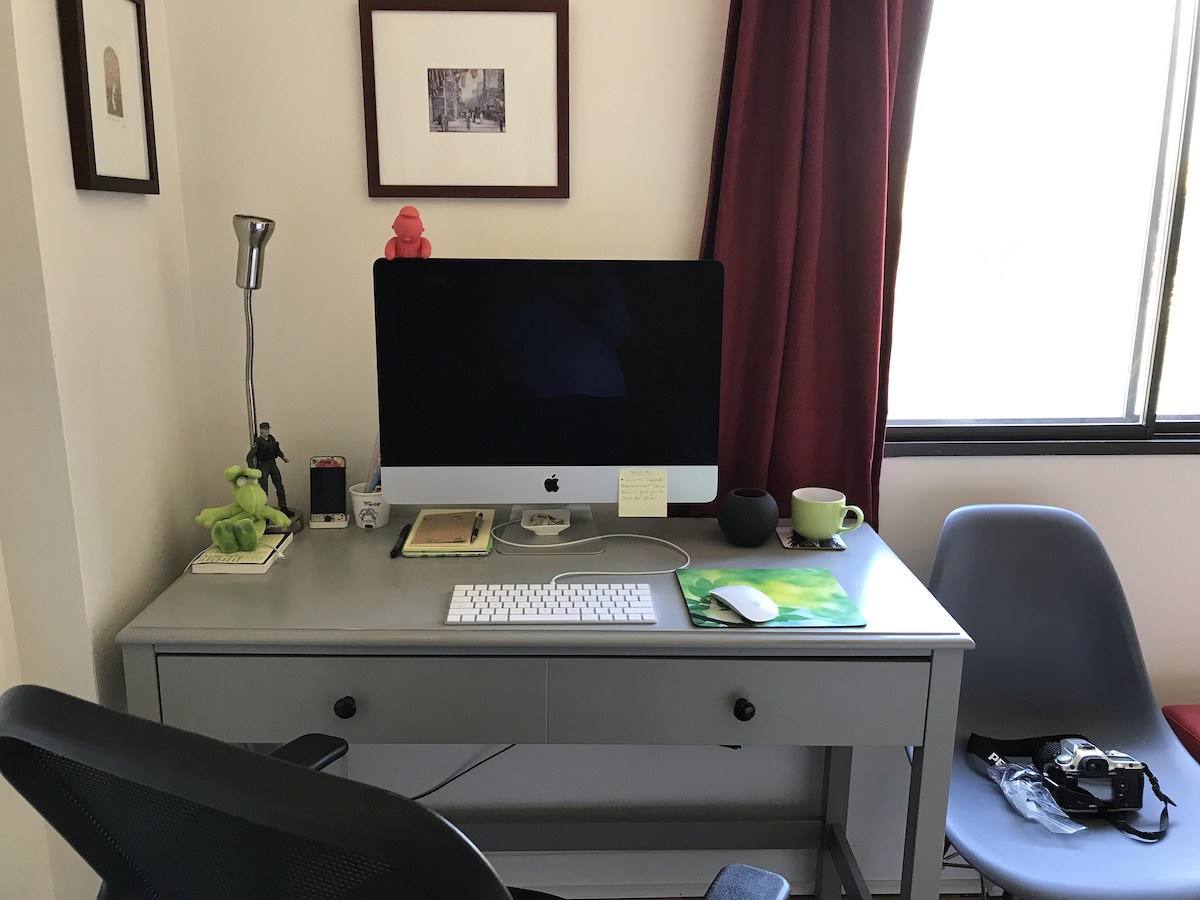
First up, you won’t see an image of my iPhone 16 Pro in the shot below because, you know, I needed something to take a snap with. But yeah, I only just upgraded to the 16 early last year so I’m probably an iteration behind everyone else. And yes, lust after owning an iPhone 17 pro. Yes, in cosmic orange. 

But maybe I’ll see what colours they come out with next year on whatever phone drops by then. After all, I need to get my money’s worth out of this one first. iPhones ain’t cheap, as we all know.

So, what else is in the shot above? My aging (and ain’t we all, Darlin’) iMac 17” from 2017. Yes, it’s old but guess what, it still works perfectly. A little bit like me. It has all the essential Apple software aided and abetted by the likes of Pixelmator Pro, which I use less frequently than I use to. I barely crop shots these days on the grounds if I didn’t get what I wanted when I pushed the button, fiddling around in software ain’t gonna make it better.

So all the images I share online are exactly as I saw them through the lens, more or less. No fiddling with colours or saturation, or filtered this way or that. 

Baby Brilliant, the tiny bright pink fella hanging over the top of my screen, oversees my work and, let me tell you, is a little too critical of all my spelling mistakes. Like he would know English anyway. But I digress … where was I? 

Oh, yes, on the grey guest chair next to my desk you’ll see one of my four (4) cameras. Yes, I know, I have a small collection, of which, this one, the lightweight Pentax ist-D* is my go to. Which is why it’s sat on the chair, always ready to go when I decide to head on out for a walkabout. [you can see some photos here.]

I absolutely love this workhorse of a camera — I’ve had it for a couple of decades now. It runs off AA batteries, which last well over a year. No recharging every five minutes, and no worrying about carrying spares, or chargers. I can nip into almost any magazine shop and buy batteries on the fly.

Two of my other cameras are the Pentax Q10, a dinky little lightweight with a D6 telephoto zoom lens. It’s so neat as I can literally throw this in my bag and go. Honestly, it’s too cute for it’s own good and takes great snaps. My other go-to is an Olympus Pen, one of the originals, the E-PL2. I’m not sure they even sell this one anymore. I think they’re on the 5th or 6th iteration. 

Again, it’s light, easy to use, and takes great snaps. I love the pancake lens I bought to go with it, as it’s great for landscapes and wide vistas. 

Rounding out my kit is an iPad air that get’s used mostly to read the news or play my farm game, Hay Day. But I’m sure glad I had it last year, when we were in Montreal, as it was invaluable.

𖡼.𖤣𖥧𖡼.𖤣𖥧

The Reckoning by James McGee

THE RECKONING is not a book for the faint of heart, nor anyone who doesn’t like animal cruelty, violence, or graphic action in a fight scene. That’s because author, James McGee, accurately portrays the gritty underbelly of early 19th century London, when Britain is at war with France, and the Napoleonic Wars raged across Europe.

This is McGee’s sixth novel in the Matthew Hawkwood series, but my first outing and not to be my last. The author skilfully makes this easy to read as a standalone, without the need to have read previous installments. Any references made to previous escapades and adventures are all told within the context of the story, and add to the over-all story and background of our erstwhile hero, Hawkwood. A man who’s as straight as an arrow, and happy to bend the wrong rules for the right reasons. Especially in pursuit of justice for a killer’s victims.

I thoroughly enjoyed the rich detail that McGee has woven into a tight tapestry of what life was like during this period, in English history. And loads us up with plenty of intrigue on any number of levels. Not just a murder mystery, with Officer Hawkwood trying to trace a killer with little or no clues to go on. This is also a political thriller, with plenty of insight to the inner workings of the government, or, I should say, a number of departments, and high society of the day. Specifically, the warped sexual proclivities of the upper echelon and their ilk.

It is McGee’s descriptions of this sordid world, that while repugnant, show us just how life was for so many—the struggle for survival on a daily basis, brutal and cutthroat. And yet, within this world there are moments of lighthearted banter, jovial comradeship, and small slither of light. It is not all darkness and gloom, not all pain and drudgery.

McGee also lightens the load with wonderfully drawn characters, Hawkwood may carry the bulk of the story, but the other characters are as well crafted and fully fleshed out. I specifically like Jago, a rapscallion of a man who is Hawkwood’s right hand man, and has Hawkwood’s back. Then there is James Read, the Chief Magistrate at Bow Street, and Hawkwood’s ‘boss,’ who is the ‘moral’ compass, and even Read’s clerk, Twigg, was someone you don’t soon forget, as he provided some droll moments of humour. Even the Coroner’s surgeon, Quill, in his ‘death’ house, provided a welcome chance for the author to provide us with some great banter back and forth.

With plenty of colourful, engaging characters, going up against the entrenched bureaucracy of Brooke, Addington and Saxby, and with some keenly written snappy dialogue, McGee weaves an excellent story to a very real backdrop of history. He combines plenty of action and yes, plenty of violence, to keep a reader turning the page. And for me, this was a real page turner. I read THE RECKONING over two days, sucking up and relishing every detail.

While I enjoyed this novel, I will admit it might not be to everyone’s taste. As I stated, there is plenty of violence within the context of the story, and in part, the details are a little on the grisly side—but never overly gory, at least, not for me. If you like your murder mystery with a historically accurate background, a bunch of well-shaded characters, and a lot of period action (pun intended) then you will probably enjoy this one as much as I did.